ACTIVITIES
SHINRIN YOKU
What a forest bath is
The forest bath, the literal translation of the Japanese shinrin yoku, is a sensory immersion in the forest, undertaken with a focus on well-being and health.
This practice originated in Japan in the 1980s when scientists demonstrated the benefits of a walk in the forest on our body in general. As such, a forest bath can be prescribed by a Japanese doctor just like any other recommendation aimed at improving our health.
A forest bath lasts about 2 to 3 hours knowing that many studies have shown that after only 40 minutes of walking, participants see their stress levels, heart rate, and blood pressure decrease.
It is possible to undertake a forest bath in any season, even if winter is somewhat less favorable. The course generally follows manageable, not too steep trails, with excursions into the heart of the woods. The presence of water, in all its forms, is an additional call to open the senses.
The forest bath is a special moment, a time for oneself, a letting go, an opportunity to live in the present moment, a constantly renewed wonder. It is a beautiful encounter with nature, with others, and with oneself.
What a forest bath is not
The forest bath is not a true sporting activity and does not require significant physical exertion.
There is no goal to be achieved within a given time.
It is also not a botanical outing to learn about tree species, plants, or forest residents.
That is not the essence, but your guide can, to the best of their knowledge, answer your questions or draw your attention to something particular...
Benefits for health
Japanese scientists studied why walks in the forest provide a sense of well-being and beneficial effects on health through rigorous experiments with control groups.
They found that an exposure of about 2 hours in a forest acted on the following levels:
mental : reduction of stress (decrease in cortisol) and anxiety, facilitation of sleep, prevention of depression, restoration of attention, enhancement of cognitive abilities and creativity;
cardiovascular and digestive : slowing of heart rate and strengthening of its variability, reduction of blood pressure, facilitation of digestion;
immune system : stimulation and strengthening of the immune system, increase of NK cells and anticancer proteins.
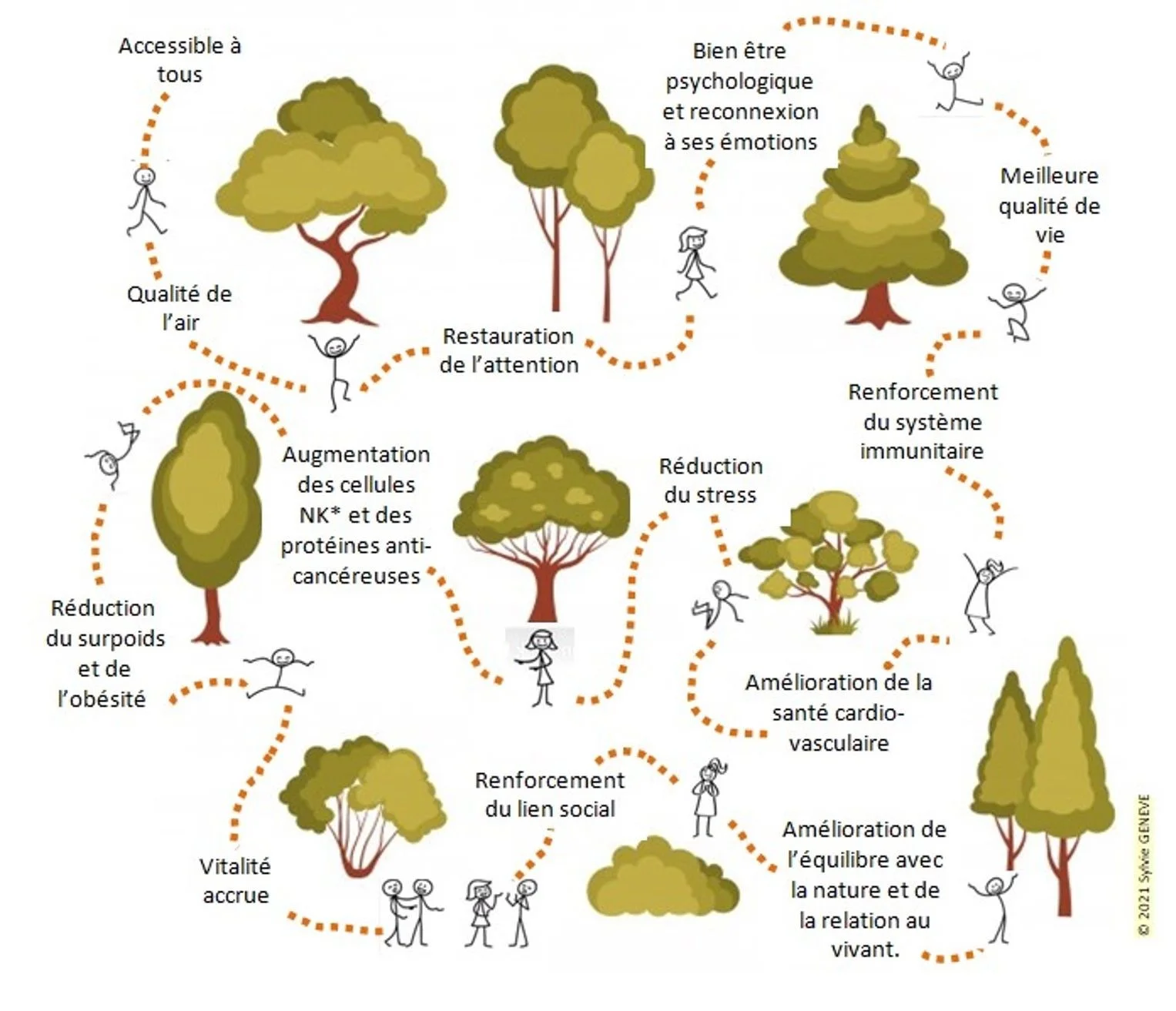
Effects and benefits of forests and nature on human health ( Copyright - 2021 - Sylvie GENEVE)
And more generally, strengthening of mood (serotonin production), vitality and energy, … even libido!
Some explanations:
The prevalence of blue and green colors is calming for the mind.
Sounds provide a natural sedative effect, which:
- lowers blood pressure and brain activity;
- relieves our body of any muscle tension.
Walking induces many positive effects on the body:
- improvement of immune functions;
- reduction of stress hormone levels.
Finally, trees release volatile organic compounds, including phytoncides:
- once inhaled, they boost our immune defenses;
- they differ from one forest to another and depend on humidity levels, lighting, atmospheric pressure, density, and tree species.
The process of a forest bath
Welcome: introduction of everyone and what will follow.
Activities: short linking walks, strolling sequences or on-site with an invitation from the guide appealing to the senses, for an individual or group exercise, and sharing circle at the end of the sequence.
Examples of invitation:
hearing: listening to the songs of birds, the wind in the leaves, the sound of nearby streams, ...
smell: sensing the bark of trees, the fragrance of flowers, the scent of the underbrush, …
sight: observing the landscape, the shapes of plants, the colors of leaves, ...
touch: feeling leaves, moss, collected objects, ...
taste: inhale the air, absorb nuts, berries ...
Circle of sharing at the conclusion of the bath.
Tea ceremony before parting ways.
Any questions?
- What equipment should I bring?
Warm and comfortable clothing suitable for the season, especially if rain is forecast. Sturdy shoes that can handle rocky ground. A ground mat or any means to sit or even lie down on the ground. And a small bag for miscellaneous items (including your phone, preferably in airplane mode!).
- Are there any contraindications to forest bathing?
It's an easy exercise that requires little effort and is accessible to everyone. However, do not hesitate to inform your guide before any outing if you have a particular problem.
- Can I participate with my children?
Yes, it is possible, but it is at the guide's discretion; you should discuss it with them.
- What should I take with me?
Something to drink, a raincoat just in case, and above all your good mood!
- What risks does the forest present?
The guide ensures your safety and takes you to areas they know that do not present any particular danger. However, be cautious of ticks during the season. Make sure you are covered and check yourself when you return. Ticks can be easily removed with a tick remover, which guides are usually equipped with.
- How can I make the most of my forest bath?
Expect nothing in particular, disconnect, forget the time, breathe, focus on the present moment, look, feel, touch and listen, be attentive to your feelings, enjoy, enjoy the moment again...
____________________________________________
FOREST THERAPY
Forest Therapy is an intervention based on nature that addresses "health as the result of a process of adaptation of the human being to their physical and social environment." Forest Therapy aims to promote positive mental health states, improve physical and social health by strengthening the connection with nature, interpersonal relationships, and social cohesion.
Ultimately, it serves as a bridge between health and the physical, mental, social and spiritual well-being of the person and their environment.
Forest Therapy has a multidisciplinary approach stemming from fields such as planetary health, forest medicine, sociology, psychology, social work, emotional ecology, ecology, and forestry, among others. Supported by this multidisciplinary approach, Forest Therapy can act as a complement to standard treatment and rehabilitation of specific diseases.
What is the role of the forest therapy practitioner?
- He prepares and facilitates interventions supporting activities for connecting to nature and expressive arts, for prevention, limiting effects, or treatment and rehabilitation for mental health disorders;
- He collaborates with health professionals to carry out interventions and adapt them to specific population groups (by age, social context, pathologies);
- He evaluates interventions concerning risks and outcomes.
For example, interventions proposed by a forest therapy practitioner, and according to the needs and objectives expressed by health professionals, can be designed to address nature-related issues:
- Behavioral (empathy, ... )
- Cognitive (concentration, attention, ... )
- Emotional (self-esteem, aggression, ... )
- Systemic (social interaction, group cohesion, ... )
Unless specifically trained, the forest therapy practitioner is not a therapist, but their interventions with teams of health professionals have a therapeutic approach and virtues.